
An Instructional Leadership Team’s Journey to Strengthen Student Discourse and Support Multilingual Learners
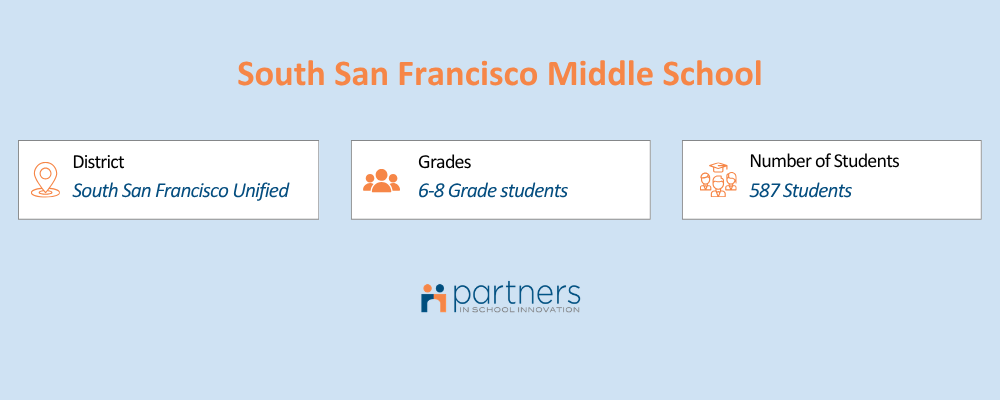
At a middle school in South San Francisco, school leaders partnered with Partners in School Innovation coaches to build the capacity of their Instructional Leadership Team (ILT), with a focus on strengthening academic discourse so that all students, especially multilingual learners (MLLs), had consistent opportunities to develop academic language.
Centering Student Discourse to Support Multilingual Learners (MLLs)
During the 2024–2025 school year, the team named a clear guiding question to focus their work:
How can we increase true, back-and-forth peer-to-peer conversation so that all students regularly have opportunities to think, talk, and learn together?
This question came after early walkthroughs revealed that students were rarely engaging in conversation with one another, prompting the team to take a closer look at what was happening across classrooms.
Seven ILT members across content areas led this work, including two teachers who taught English Language Development (ELD). These classrooms became an important place to study how academic discourse could support multilingual learners over time.
The first step was building the ILT’s understanding and capacity to do this well, so they could then spread the work across the school in a way that supported shared leadership.
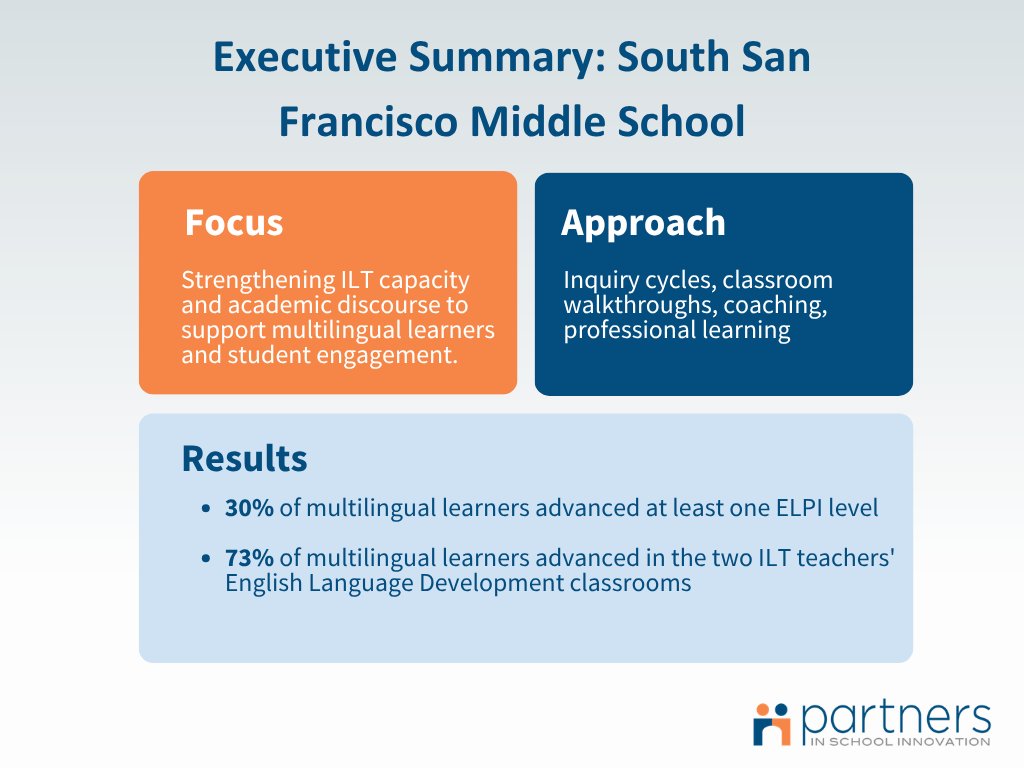
By the end of the 2024–2025 school year, leaders hoped to see multilingual learners demonstrate growth by advancing at least one level on the English Learner Progress Indicator (ELPI). By the end of the school year, the impact of this sustained focus on academic discourse was already visible.
Among multilingual learners with ELPAC results in both years, 30% increased by at least one ELPI level. Growth was strongest in classrooms where the work on academic discourse had been underway the longest. In the two ILT teachers’ ELD classrooms, where this work was most deeply explored, 73% of multilingual learners advanced at least one ELPI level.
Designing Professional Learning to Strengthen Student Discourse
With support from their Partners coach, the ILT focused on building their own capacity to study and improve academic discourse. Rather than introducing strategies right away, the team focused on learning from their own practice first. Their ILT partnered with Partners in School Innovation to design a learning arc focused on understanding how academic discourse was showing up in classrooms so they could define what support was needed to strengthen it.
Together, Partners coaches and the ILT organized this work into inquiry cycles. These inquiry cycles were short, structured periods of learning where teams named a focused question, collected evidence from classrooms via walkthroughs, analyzed what they saw, and adjusted their approach to discourse based on what they learned. This structure allowed the team to test ideas, study practice, and refine their focus over time.
Partners coaches supported this work by helping the ILT strengthen how they worked together as a team. This included shifting ILT time toward teaching and learning, introducing a clear theory of action, and grounding the team’s learning in research on academic discourse and multilingual learners that helped the team sharpen their questions, facilitate reflective data conversations, and track learning over time.
Using Walkthroughs to Understand and Refine Student Discourse Strategies
Rather than using walkthroughs for evaluation, the team treated them as a learning tool, returning again and again to one guiding question:
What does meaningful academic discourse look like for students in our classrooms?
These walkthroughs of ILT classrooms were paired with coaching conversations and professional learning, so evidence from classrooms could directly inform next steps.
Refining Walkthrough Tools to Capture the Quality of Student Talk
With coaching support, the ILT treated their walkthrough tool as a living document. Over the school year, they refined their walkthrough tool to move beyond noting whether discussion was happening and instead to capture the quality of academic discourse. This included how students were interacting with one another, whether they were building on peers’ ideas, and how academic language was being used.
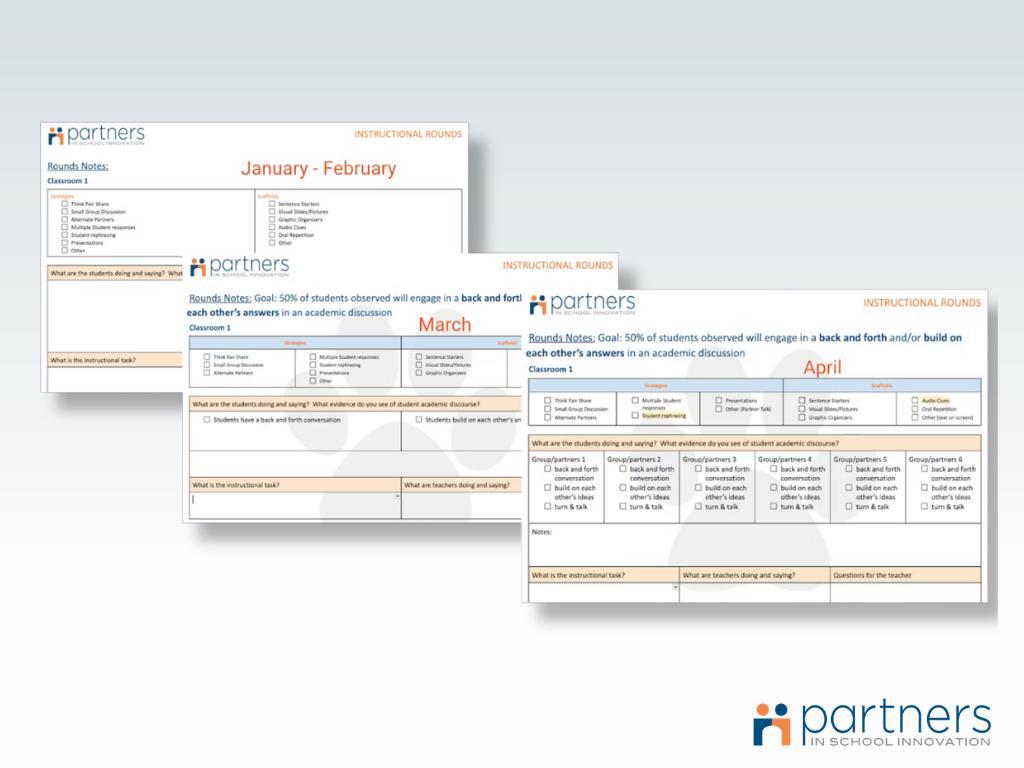
👉 View the final walkthrough form they used here.
Building Trust Through Peer Observation
Opening classrooms to observation was itself a shift for the team. Teachers were initially hesitant to have peers observe their instruction, so the ILT started with self-reflection, having members assess their own classroom discourse before inviting others in. By March, ILT members began observing each other's classrooms directly, building the trust needed to learn from one another's practice. This progression culminated in the final inquiry cycle, when observations expanded beyond ILT classrooms to understand how discourse was showing up across the school.
Getting Clear on Strategies for Academic Discourse
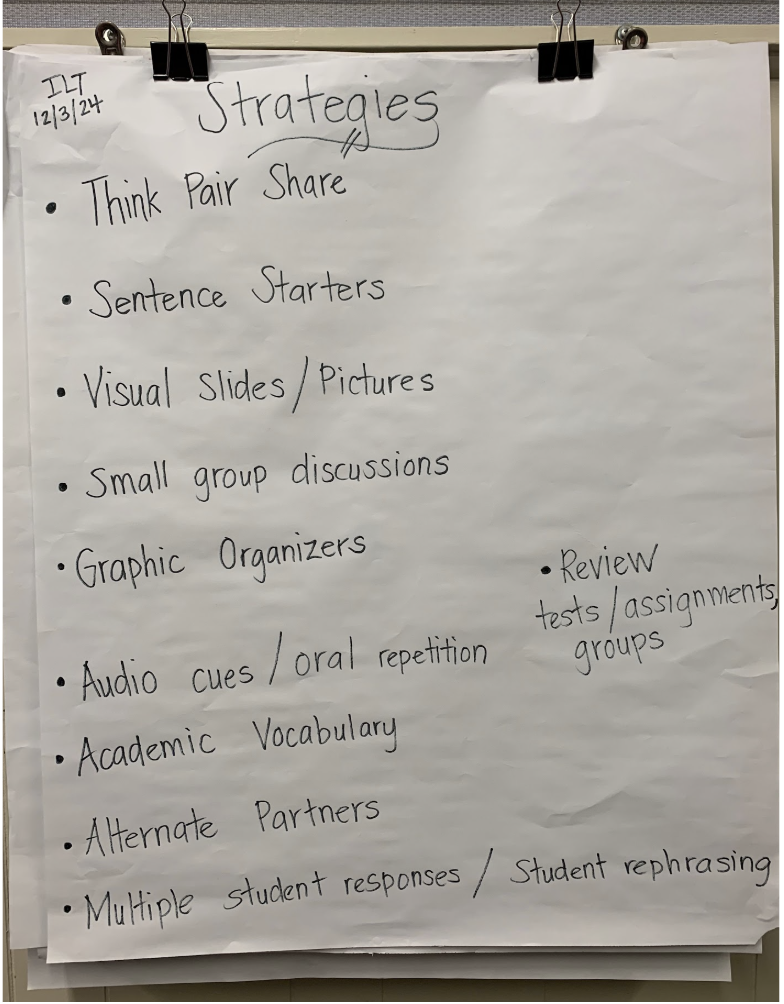
As the ILT deepened their work, they began to build a shared understanding of what strong academic discourse looks and sounds like in practice. Rather than relying on individual interpretations, the team worked together to name the student and teacher moves that supported meaningful conversation.
Check out the tool we used for tracking academic discourse look-fors here. This is a non-evaluative tool that supports teams in naming and tracking specific student and teacher behaviors that strengthen academic discourse.
Tracking Progress Over Time Through Walkthrough Data
As the inquiry cycles continued from January through March, walkthrough data showed increased use of discussion structures and strategies like think-pair-share and small-group conversations in the ILT classrooms. Instructional scaffolds, including sentence starters, visual supports, and graphic organizers, became more common across classrooms.
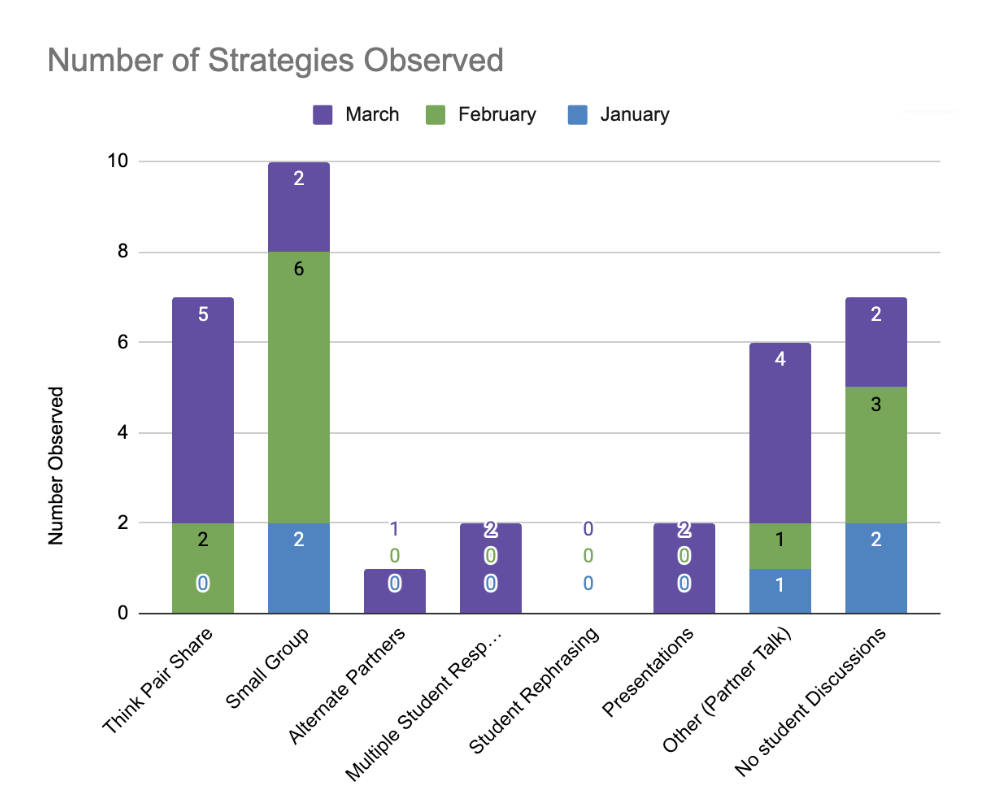
The team also set a clear process goal for March. They predicted that 50% of student groups observed in ILT members’ classrooms would be engaged in true back-and-forth conversation. When they reviewed the data, they found that 70% of groups met that criteria, exceeding their prediction.
This progress gave the team confidence that their efforts were making a difference. It also helped them see what to focus on next. As more students began engaging in conversation, the ILT noticed that students were engaging in conversation, but there were still opportunities to deepen how they responded to and built on one another’s ideas.
This led the team to build more on the quality of discussion and expand their observations beyond ILT classrooms to better understand what was happening across the school.
What the ILT Learned About Strong Student Discourse
By the end of the inquiry cycles, the ILT had a much clearer picture of what supports meaningful academic discourse. Four components rose to the surface again and again:
Room and space setup, including how physical environments support or limit conversation
Discussion structures that create real opportunities for peer-to-peer talk
Scaffolds that help students sustain and deepen dialogue
Quality of discussion, looking beyond participation to rigor and depth
This shared clarity gave the team a strong foundation for continued action. Instead of guessing what works, they could expand the work beyond the ILT grounded in what they had learned and tested together.
Results: Impact on Multilingual Learners and Leadership Capacity
By the end of the 2024–2025 school year, this middle school in South San Francisco had made meaningful progress, not only in classroom practice but in how leaders and teachers learned together.
Growth on the English Learner Progress Indicator (ELPI)
Among multilingual learners with assessment data in both years, 30% increased by one or more ELPI levels.
Growth was strongest in classrooms where the work had been underway the longest. In the two ILT teachers’ ELD classrooms, 73% of multilingual learners advanced at least one ELPI level.
Strengthened, Sustainable Instructional Leadership Team (ILT) Capacity
Beyond the numbers, the school built lasting capacity. Their ILT strengthened their ability to:
Collect and analyze instructional evidence
Refine and create tools to better capture student experience
Develop shared expectations for teaching and learning.
As a result, the school entered the following year with clearer goals, strengthened capacity, and a data-informed plan for continuing to deepen academic discourse across more classrooms.
Looking ahead
The ILT is continuing this work in alignment with district professional learning, with a stronger focus on the quality and rigor of student conversation. With support from their Partners coach, the school's leadership and ILT are now expanding this work to the entire staff.
The look-for tool shared during August PD became the starting point for the following year's walkthrough tool, which the ILT has since adjusted further. The team has also been exploring how the complexity and rigor of a discussion prompt shapes the complexity and rigor of the resulting student discussion, a focus now expanding district-wide alongside a new push for peer observations.
Interested in Strengthening Student Discourse in Your School or District?
Check out our free online Classroom Walkthroughs course
Our course on classroom walkthroughs is for education leaders and teacher-leaders who want guidance on how to set up reliable walkthrough systems that support developing a shared vision for instruction and a culture of continuous learning and shared leadership. Sign up for the free online course.
Work with a Partners in School Innovation Coach
If you're interested in learning more about how Partners in School Innovation can support your district’s and school's path to transformation or want to explore how our staff can empower your team to achieve exceptional outcomes, contact us today.
