
Designing Professional Learning for Teachers (Using Adult Learning Science)
When you’re facilitating professional learning, what often makes the difference between an experience that fades and one that sparks real change is how the learning is designed. Strong adult learning happens when it’s grounded in learning models that help adults do more than take in information. People learn best when they’re prompted to reflect, connect, and apply what they’re learning in ways that shift both their mindset and practice.
One learning model our coaches often draw on at Partners in School Innovation is John Heron’s Experiential Learning Cycle. This model draws on his research that found that adult learning involves more than ingesting information (cognitive learning) and doing (practical learning), and instead highlights two other layers that are often overlooked in planning professional learning: emotion and meaning-making.
When professional learning intentionally attends to how adults feel and how they make sense of their experiences, it creates the conditions for deeper, more lasting change.
Why Professional Learning Should Cover More Than Content
Many professional learning experiences focus heavily on strategies, frameworks, and planning tools. While those matter, research shows that adult learning that leads to transformation must also attend to emotion, imagination, and lived experience, not just cognition.
John Heron’s Experiential Learning Cycle offers a holistic framework that can be applied for when you're designing professional learning experiences for your school staff and community, especially those that will cover challenging topics or change management. Rather than treating learning as a single event or a checklist of activities, it helps facilitators consider the different ways adults experience and process learning, and how those experiences build on one another.
Heron’s Experiential Learning Cycle and Adult Learning
At the heart of John Heron’s model is the idea that adults learn in more than one way. He suggests that we experience learning through four connected modes of the psyche, and each supports a different part of how we make sense of new ideas and translate them into action.
Affective learning mode – Where participants feel and connect emotionally to the content
Imaginal learning mode – Where participants make meaning, imagine possibilities, and create shared vision
Cognitive learning mode – Where participants build understanding and make sense of new information
Practical learning mode – Where participants apply learning and take action
For professional learning to be effective, facilitators are encouraged to intentionally design experiences that touch all four of these modes. As coaches and professional learning facilitators ourselves, we’ve seen how powerful learning experiences can be when they are grounded in the affective and imaginal modes before moving into cognitive understanding and practical application. When each mode builds on the one before it, it creates a stronger foundation for learning that sticks.
Below, we’ll look at each mode more closely and explore how it can show up in professional learning design.
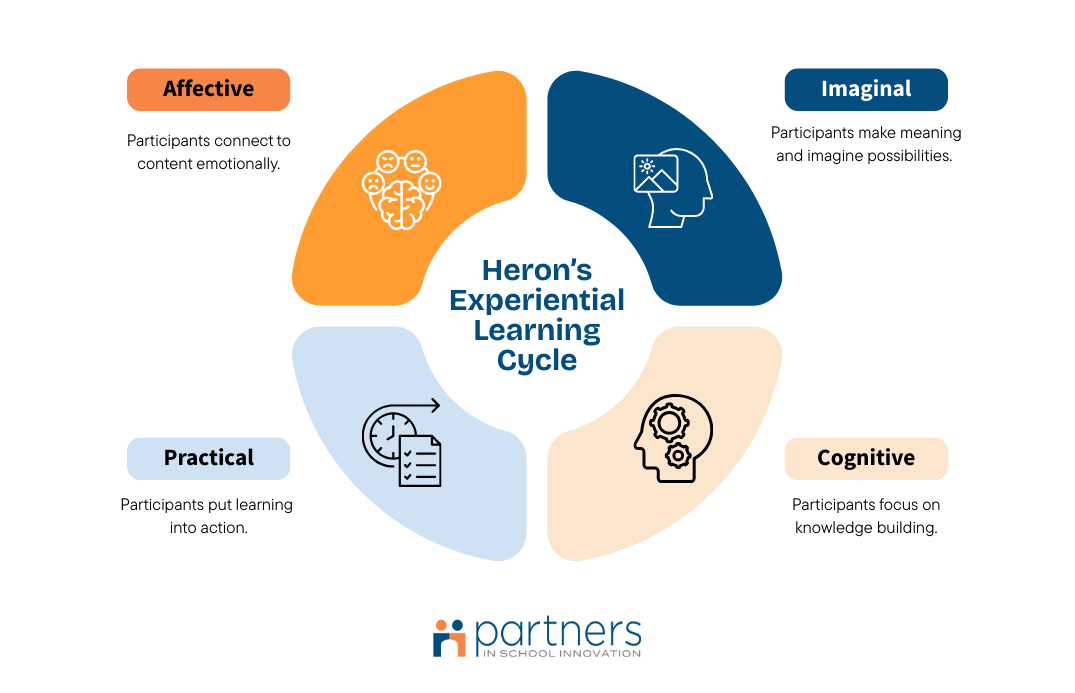
Image description: A visual graphic illustrating the four modes of adult learning in John Heron’s Experiential Learning Cycle: affective, imaginal, cognitive, and practical. The graphic shows how these modes work together to support whole-person learning. (Source: Partners in School Innovation)
Affective Learning Mode: Creating Safety, Connection, and Relevance
The Affective mode is where you take time to center emotion, relationships, and lived experience during professional learning. This is where you help participants feel seen, heard, and connected to why the learning matters. When this mode is skipped, professional learning can feel transactional or disconnected from educators’ day-to-day realities. When it’s intentionally included, trust grows, and participants are often more open, more reflective, and more willing to take risks in their thinking and practice.
What the affective mode supports
Psychological safety
Emotional readiness for learning
Connection to purpose and values
What the affective mode can look like in practice
Asking participants to journal and reflect on personal or classroom experiences relevant to the topics being covered.
Leading warm-ups that invite participants to share lived experiences that are relevant to the topics being covered.
Facilitating structured listening in pairs or small groups to help participants feel heard and build trust before moving into deeper learning.
For example, you might invite educators to reflect on a recent moment when they felt uncertain about how to support a student. Beginning this way signals that the session is rooted in shared learning, not evaluation.
Guiding question when planning:
What opportunities do participants have to share experiences and connect with how this learning shows up in their real work?
Imaginal Learning Mode: Making Meaning and Expanding Possibility
The imaginal mode is where you can encourage adults to begin to make meaning and imagine what could be different. Here, it’s encouraged to bring in practices that invite creativity, vision, and perspective-taking, with the intent to help learners move beyond their current reality to envision new possibilities.
This mode is especially powerful when teachers or leaders are being asked to rethink long-held beliefs, examine assumptions, or envision more equitable ways of working. It creates a bridge between emotion and understanding.
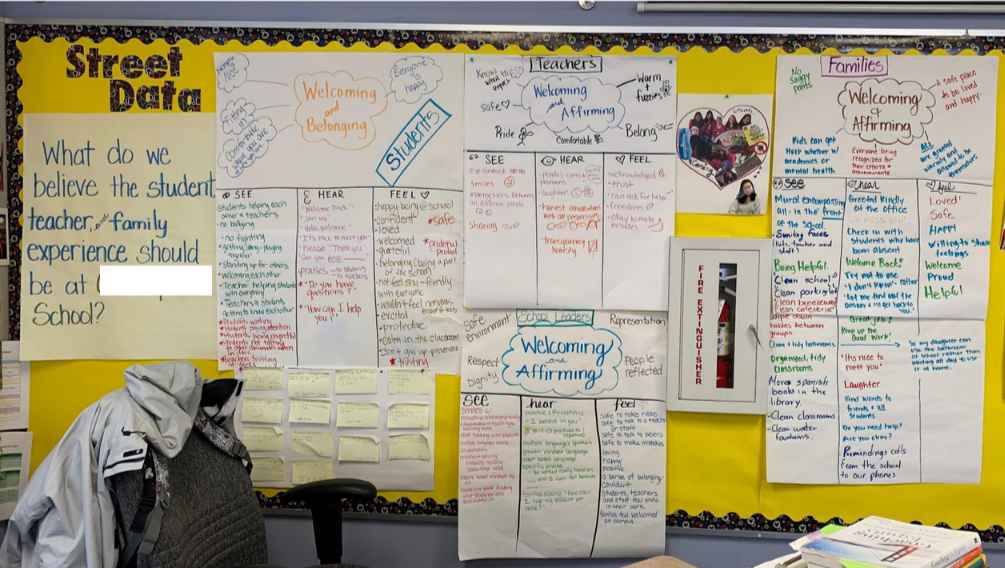
Image description: A photo from a collective reflection session facilitated by Partners in School Innovation. This school team was asked to respond to the prompt, “What should the student, teacher, and family experience be at our school?” and capture their ideas visually on chart paper.
What the imaginal mode supports
Shared vision
New perspectives
Deeper meaning beyond surface-level strategies
What the imaginal mode can look like in practice
Guided visualizations of future classrooms or student experiences
Visual thinking tools like maps, charts, or diagrams
Design-thinking activities that encourage creativity before moving into solutions
Light creative expression like sketches, short skits, or symbolic representations to surface shared understanding
For instance, a facilitator might invite educators to imagine walking into a classroom where all students feel a strong sense of belonging and engagement. Participants are asked to picture what they notice first. How students are interacting. What the teacher is doing. What feels different from today? This helps educators clarify what they are working toward before naming strategies or actions.
Guiding question when planning:
How are participants invited to envision, imagine, or make meaning before moving into content?
Cognitive Learning Mode: Building Shared Understanding
For many facilitators, the strategies in this mode are probably the most familiar. Cognitive learning is important, but it’s most effective when it follows facilitated activities grounded in the affective and imaginal modes. Without that grounding, content can feel abstract, overwhelming, or disconnected from practice.
Cognitive learning mode focuses on thinking, language, and knowledge-building. This is where we want to have participants engage with concepts, frameworks, and research to deepen their understanding.
What the cognitive mode supports
Shared definitions and frameworks
Clearer understanding of new ideas and skills
Alignment around language and approaches
What the cognitive mode can look like in practice
Reading and discussing research or case studies, with space for reflection and discussion
Facilitating conversations to align on common language
Introducing new ideas through facilitator-led content or short presentations
For example, a facilitator might share a research-backed approach to data-informed instruction and intentionally tie it back to what participants named and imagined earlier in the session.
Guiding question when planning:
How are participants being supported to build shared understanding, language, and clarity around new ideas, concepts, or frameworks?
Practical Learning Mode: Turning Learning to Action
The practical mode is where learning moves from conversation into action. This is where participants decide what they will try, change, or implement in their own contexts.
When this learning mode follows the others, this step feels purposeful rather than rushed, and participants will be clearer on what they’re doing and why. And that’s what increases the likelihood that changes will stick.
What the practical mode supports
Turning ideas into concrete next steps
Shared responsibility and follow-through
Momentum beyond the session
What the practical mode can look like in practice
Identifying one or two actions to try in classrooms or teams
Naming short-term goals or intentions connected to the learning
Planning how and when the team will check in on progress
Making clear agreements about next steps and shared responsibility
For instance, a team might leave a session with a clear plan to try one new instructional strategy and a commitment to revisit its impact together at a future meeting.
Guiding question when planning:
How are participants invited to translate learning into concrete actions they can try, adapt, and reflect on in their own context?
Why Order Matters in Professional Learning
One of Heron’s key insights is that jumping too quickly into content or action can limit learning and reduce long-term impact. When professional learning is grounded first in emotion and meaning, adults are better prepared to understand and apply new ideas. This is especially important in equity-focused work, where identity, culture, and lived experience shape how adults engage with change (Trompenaars & Hampden-Turner, 1997).
This is especially important in equity-focused work, where emotions, identity, and lived experience shape how adults engage with change.
Free Reflection Template
To support this work, our coaches at Partners have developed a reflection tool that you can use to reflect on the professional learning plans you develop for your teachers. It will help you step back and ask:
Which learning modes are present?
Which are missing?
Where might we slow down or reorder?
Access our Facilitation Agenda Reflection Tool here.
Want more tools for leading adult learning?
If you’re a school or district leader looking to strengthen your adult learning design and facilitation, you don’t have to do it alone.
Join our free Partners in School Innovation online community, where educators access:
Practical tools for adult learning and facilitation
Courses like Data for Liberation and other equity-centered learning experiences
Resources, templates, and examples from real schools
A community of leaders learning alongside one another
