
Understanding the Stages of Team Development in Schools (And How Leaders Can Respond)
Most school leaders are guiding multiple teams at once - from instructional leadership teams to grade-level teams - and often while navigating shifting priorities and limited time.
When a team isn’t moving forward the way we hope, it’s easy to assume something is wrong with the people in the room. But in our work as coaches of school and district leaders, we’ve seen again and again that what teams need most isn’t fixing but support that matches where they are in their development.
Teams grow in phases. And the strategies that help a team move forward depend on the phase they’re in, not just the outcomes we want to reach.
Why One-Size-Fits-All Team Strategies Fall Short
Many of us were taught to lead teams by focusing quickly on goals, action steps, and accountability. Those things matter. But teams are human systems, and they don’t develop in a straight line.
We often see teams struggle when:
Goals are pushed before purpose feels clear
Norms are introduced before trust is built
High performance is expected before roles and relationships are established
When leaders use the same facilitation strategies regardless of what a team is experiencing, progress can stall, not because people aren’t capable, but because the support doesn’t match the moment.
What helps is having a shared way to understand where a team is and what kinds of leadership moves are most helpful at that stage.
A Framework for Understanding Stages of Team Development
One model that our coaches at Partners in School Innovation reference is the Drexler/Sibbet Team Performance Model, a research-backed framework that describes how teams develop over time and what they need to move forward.
The model outlines seven stages of team development. The first four focus on creating the conditions for a team to function well, while the final three describe increasing levels of sustained performance. Together, these stages offer a powerful way to understand not just what teams are doing, but what they need next in order to grow.
We’ve grouped them into stages below that coincide with themes that many teams are familiar with during development - forming, storming, norming, performing:
Forming (orientation)
Storming (trust building and goal clarification)
Norming (commitment and implementation)
Performing (high performance and renewal)
Rather than labeling teams or prescribing a rigid path, this model is meant to give leaders a shared framework and common language for noticing team dynamics, normalizing challenges, and choosing facilitation strategies that match where the team is. In our coaching work, we’ve seen how helpful it can be when leaders and teams can name what phase they’re in and talk openly about what support would help them move forward.
When leaders and teams can name what phase they're in, they can talk openly about what support would help them move forward.
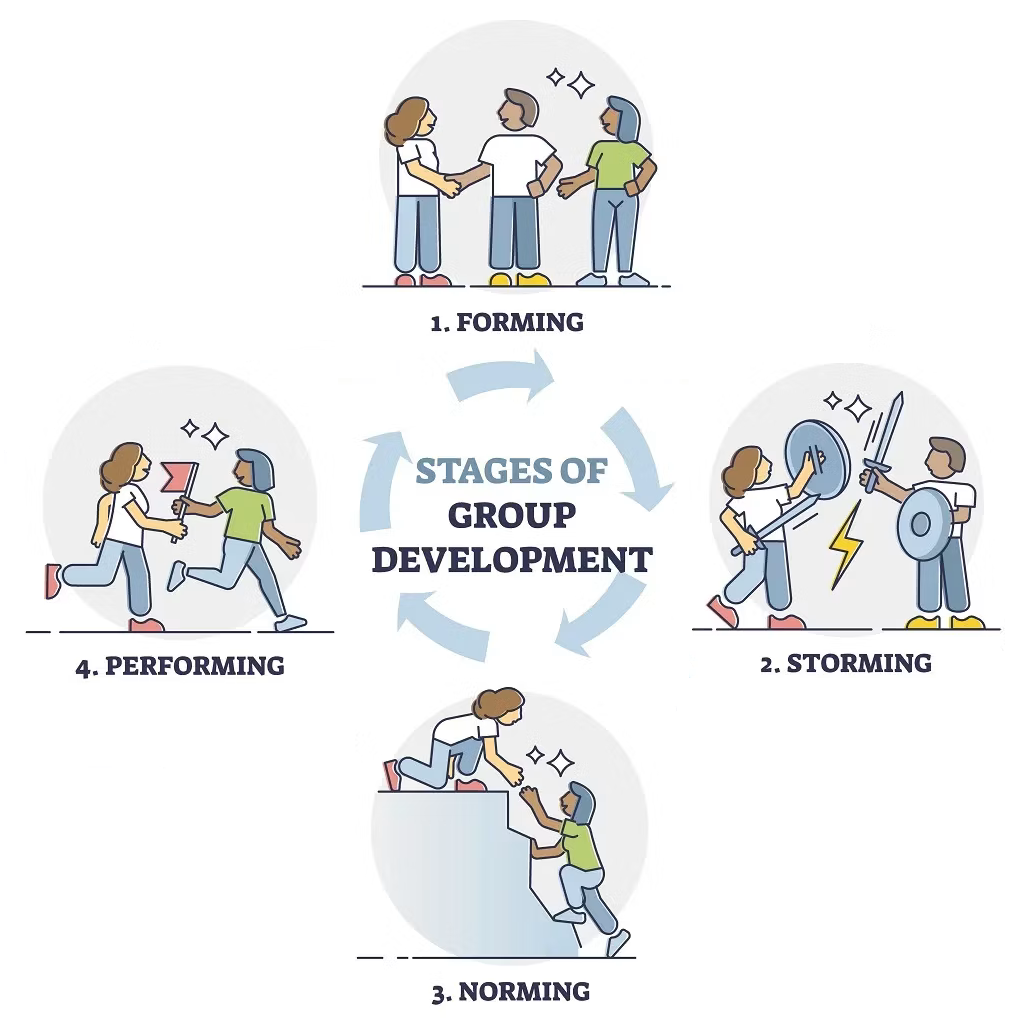
It’s also important to note that teams are likely won’t move through these stages in a straight line. It’s common to revisit earlier stages when goals shift, membership changes, or new challenges emerge, and that’s part of healthy team development.
Below, we’ll walk through what leaders often notice at each stage and what helps teams move forward from each one.
Stage 1 of Team Development: Forming
Orientation
The core question the team is asking at this stage: Why am I here?
In the forming stage, team members are often polite, cautious, and compliant on the surface. They show up, follow the agenda, and look to the facilitator or leader for direction. At the same time, many people are quietly wondering how this team fits into their already full plates.
What’s really happening beneath the surface
Team members are trying to understand the purpose of the team, their role within it, and whether their time and expertise will be valued. Opinions and concerns tend to stay private until there’s more clarity and a sense of safety.
Coaching moves that help teams move forward
At this stage, your role as a leader is to anchor the team in purpose and possibility. That looks like:
Clearly naming why this team exists and how its work connects to school or district priorities
Helping the team envision what’s possible if the work goes well
Inviting members to share what they bring, including their experiences, skills, and perspectives
As a leader, you don’t want to skip this grounding stage because teams may comply for a while but struggle to sustain momentum later.
Stage 2 of Team Development: Storming
Trust Building
Core question the team is asking at this stage: Who are you?
As teams move beyond initial politeness, differences will likely begin to surface. You might notice louder voices dominating conversation, tension around decision-making, or moments where participation becomes uneven.
This phase can feel uncomfortable for leaders, especially in schools where harmony is often equated with effectiveness. But this “storming” shouldn’t be seen as a sign of failure. It's actually a sign that people are starting to care enough to show up more fully.
Storming is a sign that people are starting to care enough to show up more fully.What’s really happening beneath the surface
Team members are trying to understand one another’s communication styles, values, and boundaries. Power dynamics are beginning to show up, and some voices may be unintentionally marginalized.
Coaching moves that help teams move forward
In this phase, leaders should focus on building relational trust and working agreements for the team.
That can include strategies like:
Surfacing and normalizing different communication, learning, and work styles
Establishing clear norms and agreements for how the team works together
Modeling transparency and neutrality when tension arises
Actively ensuring all voices are heard, especially those that are quieter or less dominant
If leaders avoid digging into this phase, they will likely see conflict resurface later in less productive ways.
Goal Clarification
Core question the team is asking at this stage: What are we actually doing here?
Sometimes teams stall not because of interpersonal tension but because the work itself feels unclear or disconnected from people’s priorities.
What’s really happening beneath the surface
If you're noticing skepticism, low energy, or surface-level engagement from team members, it may be because they don’t see how the team’s work connects to their roles, values, or the broader school vision. Without that clarity, it’s hard to build buy-in.
Coaching moves that help teams move forward
If you notice this, as a leader that’s your cue to re-center the work around shared goals. Some helpful moves here include:
Supporting the team to define clear, shared goals aligned to school or district priorities
Making explicit connections between the team’s work and classroom or student impact
Strengthening communication between leadership and the team so expectations feel coherent
When goals are clear and meaningful, energy often returns.
Stage 3 of Team Development: Norming
Commitment
Core question the team is asking at this stage: How will we do this together?
As a leader, you’ll know you're in the norming stage when you see commitment begin to grow. Team members are more aligned, trust is stronger, and the group shifts more easily from discussion to planning.
What’s really happening beneath the surface
The team is developing shared ways of operating and beginning to take collective responsibility for the work.
Coaching moves that help teams move forward
Here, as a leader you can push your team further by strengthening structure and decision-making. A few ways you can do that include:
Establishing clear processes for how decisions are made
Supporting thoughtful planning toward goals
Helping teams identify the resources and supports they need
Encouraging teams to be critical consumers of new initiatives, rather than chasing everything new
This stage is about building the habits that sustain progress.
Implementation
Core question the team is asking at this stage: Who does what, when, where?
As commitment takes hold, teams start turning plans into action. This is often where the real test of a team's readiness shows up. Team members begin carrying out the work they've agreed to, but follow-through can look different from person to person, and it's common for the team's focus and motivation to waver as the daily demands of school life compete for attention.
What’s really happening beneath the surface
The team is learning what it actually takes to carry shared commitments into daily practice. Even a team with strong trust and clear goals can lose steam here if logistics, like time, roles, and structures for accountability, aren't in place to support the work.
Even a team with strong trust and clear goals can lose steam if logistics aren't in place to support the work.
Coaching moves that help teams move forward
At this stage, leaders help the team get concrete about how the work will actually happen. That looks like:
Working with team members to get specific about logistics: time, schedules, and responsibilities
Holding team members accountable to the commitments they've made
Buffering the team from distractions that pull focus away from the work
Staying alert to signs of overwhelm and helping the team adjust its pace or scope
Teams that build strong habits for follow-through here tend to carry that same discipline into the next stage.
Stage 4 of Team Development: Performing
High Performance
Core question the team is asking at this stage: How can we get better?
Teams in this phase are working with focus and momentum. They regularly analyze progress, adjust their strategies, and hold one another accountable. A leader’s role should feel lighter here as the team operates more independently.
What’s really happening beneath the surface at this stage
There’s trust, clarity, and purpose, and it's strong enough that the team can self-correct and adapt.
Coaching moves that help teams sustain performance
As a leader, you can still support your team here by:
Celebrating progress and naming what’s working
Staying attentive to shifts in goals or context
Supporting reflection without disrupting momentum
Even high-performing teams benefit from recognition and intentional reflection.
Renewal (or Adjourning)
Core question the team is asking at this stage: Why continue?
Eventually, teams reach a natural transition point. Goals may be met, timelines may end, or the work may evolve.
What’s really happening beneath the surface
Without intentional closure or renewal, teams can lose learning or energy.
Coaching moves that support healthy transition
At this stage, effective leaders:
Create space to reflect on progress, challenges, and learning
Name what the team accomplished and what should carry forward
Prepare members for changes in purpose, composition, or next steps
Whether a team disbands or renews their work to tackle new goals, this stage honors that reflection is needed and supports continuity.

Meeting Your Team Where It Is
No team moves through these stages in a straight line. Teams may circle back to earlier stages at times when goals shift, when membership changes, or when a new priority pulls focus. What matters most isn't which stage your team is in right now. It's whether the team can name it, talk about it openly, and get the kind of support that fits the moment they're actually in.
If your team feels stuck, or you're getting ready to launch a new one, this framework offers a place to start: a shared language for what's happening and a next step toward what might help.
Want More Resources on Leading Teams?
Join Our Free Online Community of Educators
Connect with equity-focused educators who are working through the same questions your team is asking, at every stage of the journey. This is a space to learn alongside others who are building stronger, more collaborative teams in their own schools. Join the online community here.
Explore Our Free "Change Management" Course
Take your learning further with our self-paced, on-demand course Change Management. You'll find practical tools and reflective activities to help you lead your team through transitions, whether that's forming a new team, working through tension, or renewing one that's reaching a natural end. Sign up for the free course here.
Work With an Educational Leadership and Change Management Coach
If you or your team could use hands-on support with developing instructional leadership teams or leading improvement efforts at your school, our coaches can help. We offer online and in-person options to guide teams through the real work of building trust, clarity, and sustained momentum. Contact our team to learn more.
